If your boiler won’t turn on, check four things in order: the thermostat, the power switch and breaker, the fuel supply, and the pressure gauge. Press the reset button once at most. Leave the house and call for help if you smell gas, see smoke, or hear a carbon monoxide alarm.
A cold house at 6 a.m. makes everyone want a quick fix. The good news is that many no-heat calls start with something simple. A thermostat set too low, a switch flipped off, or an empty oil tank can all keep a boiler silent. A few checks take about ten minutes and need no tools.
The bad news is that some boiler problems are not safe to poke at. Gas, oil, high-temperature water, and exhaust gases are all part of the system. Knowing which checks are safe, and when to stop, matters more than any single tip.
This guide walks through what to look at when your boiler won’t turn on, in the order a technician would check it. It also covers the mistakes that make a small problem worse and the signs that mean you should call right away. Dees Plumbing and Heating provides boiler service across Dracut and nearby towns, so the advice here fits the older, cold-weather homes common in the Merrimack Valley. Use the steps below, then call for help if the boiler still will not start.
Safety First: When Not to Troubleshoot
Stop and leave the house if you smell gas, see smoke or soot, or hear a carbon monoxide alarm. Call 911 from outside. Do not flip switches, use a phone inside, or try to restart anything. Massachusetts requires carbon monoxide detectors in most homes, and an alarm means you treat it as real until a professional says otherwise.
If none of those apply, you can go through the checks below. Never open the boiler cabinet or remove covers. Never bypass a safety control.
Start With the Thermostat
Set the thermostat to heat mode and raise the temperature at least five degrees above the room temperature. Then wait a few minutes. Many systems have a short built-in delay before the boiler fires.
If the screen is blank, replace the batteries. If you have a smart thermostat, check that it still has power and a Wi-Fi connection. A dead thermostat tells the boiler nothing, so the boiler stays off.
A thermostat can also be set to “off” by accident after a power flicker or a software update. Check the mode before you check anything else. If it seems unreliable, thermostat testing can confirm whether it is the problem.
Check the Power Switch and Breaker
A boiler needs electricity even when it burns oil or gas. The controls, the pump, and the burner motor all run on power.
Look for a switch near the boiler that looks like a light switch. Some homes also have one at the top of the basement stairs. Make sure every switch is on. A home can have more than one.
Next, check the breaker panel. If the breaker for the boiler has tripped, reset it once. If it trips again, stop. A second trip points to an electrical fault, and a technician should look at it.
Check the Fuel Supply
No fuel means no heat, and it is the easiest problem to miss.
Oil boilers. Read the gauge on the tank. If it sits at about one-eighth or lower, you are probably out of oil. A stuck gauge can read wrong, so look at the tank if you can.
Propane boilers. A gauge reading of about ten percent or lower means the tank is empty or close to it.
Natural gas boilers. Check that the gas valve near the boiler is open. The handle should line up with the pipe. If your gas stove will not light either, the gas supply may be off, and your gas utility should check it.
If you run out of oil, do not keep pressing the reset button. A dry tank can pull sludge into the line, and a technician may need to bleed the system after you refill.
Read the Pressure Gauge
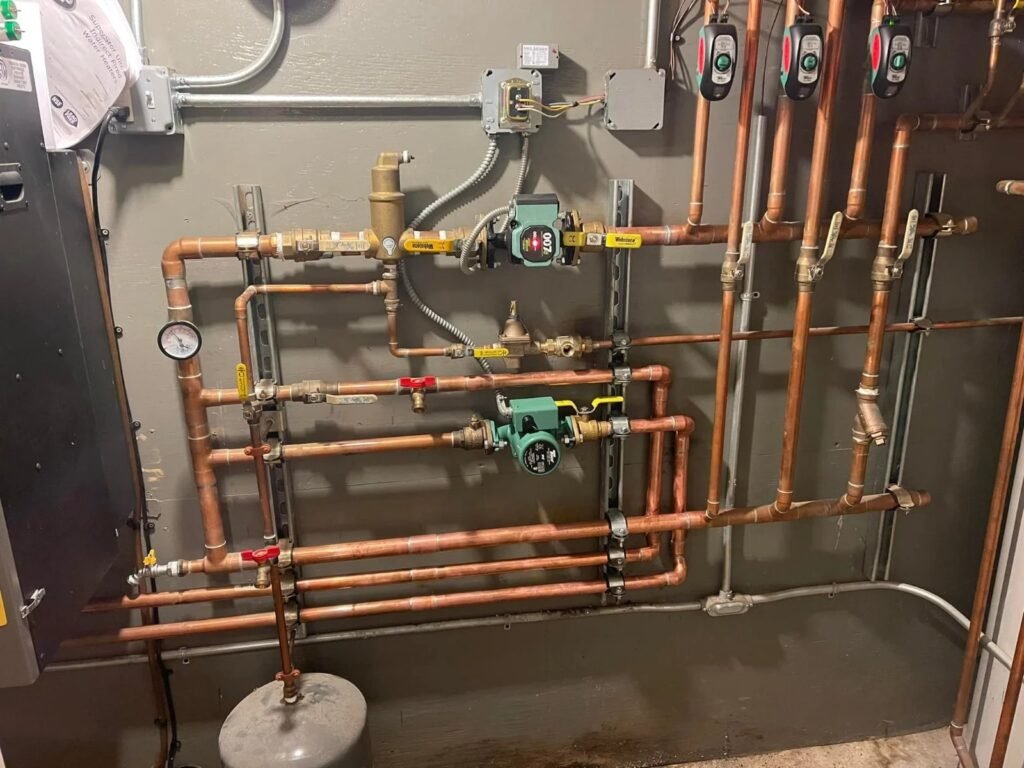
Most hot water boilers have a pressure gauge on the front or side. Your owner’s manual lists the correct range when the system is cold.
If the needle sits near zero, the system has lost water. That usually means a leak, a failed fill valve, or a relief valve that has been dripping. Write down the number and look for wet spots on the floor or around pipes.
Do not add water unless you know how your system works. Overfilling creates its own problems. Steam boilers are different. They have a glass tube that shows the water level, and an empty glass is a reason to call, not to refill.
Press the Reset Button Once
Oil burners usually have a red reset button. A burner locks out when it fails to light, and the button lets it try again.
Press it once and hold it for about three seconds. Watch to see whether the burner starts and keeps running. If it does not run for several minutes, or if it locks out again, stop. Pressing the button over and over floods the combustion chamber with unburned oil, which creates a real safety risk.
Gas boilers may not have an obvious reset button. On some, turning the service switch off for two minutes and back on clears a minor fault. Check your manual first.
What the Symptom Tells You
What your boiler does, or does not do, helps narrow the cause. Share these details with the technician.
- Totally dead: No lights, no sound. Think power, switch, breaker, or a failed control.
- Clicks but never fires: Think ignition trouble, a failed flame sensor, or an oil lockout.
- Starts, then shuts off: Think low pressure, a dirty sensor, or a blocked condensate drain.
- Runs but the house stays cold: Think circulator pump, zone valve, or air in the lines.
- Steam boiler stays silent: Think low water cutoff. This is a safety device doing its job.
What Not to Do
Some well-meant fixes cause damage.
- Do not press the reset button more than once.
- Do not relight a pilot light if you are unsure how. A wrong attempt is a gas risk.
- Do not remove panels or touch wiring.
- Do not bypass a safety switch to “get it running.”
- Do not ignore a dripping relief valve. It is there to prevent over-pressure.
When to Call a Heating Pro in Dracut
Call if the boiler is still off after the checks above. Call sooner if you see any of these:
- A breaker that trips twice
- Water on the floor or a pressure gauge at zero
- A burner that locks out again after one reset
- Banging, rumbling, or a sharp burning smell
- A house getting close to freezing, or anyone in the home who is young, elderly, or unwell
Dees Plumbing and Heating offers emergency heating repairs in Dracut around the clock. If your boiler only fails in winter, it may be asking for help earlier. A boiler or furnace tune-up before winter catches worn parts before they leave you cold.
What to Tell the Technician
A few details speed up the visit and keep your cost down:
- The make and age of the boiler, if you know them
- Your fuel type
- Any display code or flashing light
- What you already tried, including how many times you pressed reset
- The pressure gauge reading
Photos of the display and gauge help too.
Get Boiler Help in Dracut
Run the quick checks first, then stop before you take a risk. If the heat is still off, Dees Plumbing and Heating is a local plumbing and heating company in Dracut, MA ready to diagnose and fix it. Contact Dees Plumbing and Heating to schedule boiler service or request emergency help.
FAQs
Why won’t my boiler turn on even though the thermostat is set high?
The most common causes are no power, no fuel, a tripped safety lockout, or low water pressure. Check the service switch, breaker, fuel level, and pressure gauge. If all four look normal, a control or ignition part has likely failed.
How many times can I press the reset button on my boiler?
Press it once. If the burner does not stay lit, stop and call a technician. Repeated presses can flood the combustion chamber with unburned fuel and create a safety hazard.
Is it safe to add water to my boiler if the pressure is low?
Not unless you know your system. Low pressure usually means a leak or a failed fill valve, and adding water hides the cause. Write down the reading and call a technician.
Should I call for help right away if my boiler stops working in winter?
Call right away if the house is getting very cold, if anyone vulnerable lives there, or if you see water, smoke, or smell gas. If the house is still warm and the checks do not help, schedule service the same day.